Last updated October 16, 2026







Free written scope consultation - allowances, timeline, and change-order rules on paper before a single trade is scheduled
General Contractor Maintenance Checklist for Riverside Homeowners
The most expensive repair call Bradford Remodeling gets in any given year isn’t from deferred roofing. It’s from a slab crack that was visible eighteen months earlier and ignored. Expansive soils under older Riverside neighborhoods move every wet season, and the repair window closes fast. This guide gives you the specific items, intervals, and trade terms to use when you hire a construction contractor in Riverside, so you’re not paying for a generic checklist built for a Pacific Northwest bungalow.
Quick Answer
A proper home maintenance checklist for Riverside homeowners runs on seasonal intervals, not just annual ones. The non-negotiables are: a wet-season foundation and slab inspection (because expansive clay soils move every year), a pre-summer stucco and exterior seal check (UV degradation here is relentless), and a post-monsoon gutter and drainage audit. Anything less, and you’re reacting to failures instead of preventing them.
Styles & brands we work with







Table of Contents
- The Soil Movement Inspection No Generic Checklist Mentions
- Stucco Exterior Inspection: UV, Thermal Expansion, and What Cracks Actually Mean
- Warranty-Required Maintenance vs. Optional but Smart Work
- How to Document Maintenance So It Counts for Warranty and Insurance Claims
- What Requires a Licensed Contractor in California vs. What You Can Self-Certify
- The Seasonal Maintenance Schedule That Works in Riverside
- Drainage, Gutters, and the Monsoon Season Reality
- Common Mistakes to Avoid
- When to Call a Professional
- Frequently Asked Questions
The Soil Movement Inspection No Generic Checklist Mentions
Riverside sits on expansive clay soils. That’s not a construction footnote. It’s the reason stem walls crack, garage slabs heave, and interior doors start sticking in August. The soil absorbs moisture during the winter wet season and swells. Then it dries out over the long Riverside summer and shrinks. That cycle, repeated year after year, is what moves foundations. No amount of paint or caulk fixes a moving foundation. You have to catch the movement early.
Do this inspection every year in April, after the last significant rain but before the heat sets in. Walk the perimeter of your house. Look at the exposed foundation stem wall, the concrete between the soil line and the first course of siding or stucco. You’re looking for three specific things:
- Vertical cracks wider than 1/8 inch. A hairline crack under 1/16 inch is often cosmetic. A crack you can slide a nickel into is movement. Document it with a photo and a date.
- Stair-step cracking in masonry or stucco. If the crack follows the mortar joints in a staircase pattern, that’s differential settlement, not surface checking. It means one part of the wall is moving at a different rate than another.
- Gaps between the foundation and the soil. During the dry season, expansive clay pulls away from the concrete. A gap wider than a half inch means the soil is dry enough to shrink significantly, and the next wet season will swell it right back into the foundation. This is the cycle you’re watching for.
We’ve seen homeowners in older Riverside neighborhoods, the ones built on alluvial soil near the Santa Ana River, catch a stem wall crack at 1/8 inch and spend a few hundred dollars on a structural engineer’s report instead of $15,000 on a slab jack and repipe two years later. The math isn’t close.
For a full walkthrough of what this inspection looks like on your specific property, call us at (424) 567-8472. A General Contractor in Riverside who knows these soils can tell you in one visit whether that crack is cosmetic or a red flag.
Stucco Exterior Inspection: UV, Thermal Expansion, and What Cracks Actually Mean
Riverside gets roughly 277 days of sunshine a year. That’s a relentless UV load on stucco. The surface heats and cools every single day, and the thermal expansion cycle works on the stucco the same way the wet-dry cycle works on the soil. Stucco cracks happen. The skill is knowing which cracks are cosmetic checking and which ones signal substrate failure.
Cosmetic checking looks like a spiderweb of fine cracks, usually under 1/16 inch wide. It’s the outer finish coat reacting to years of thermal cycling. It’s ugly, but it’s not structural. You can patch it with an elastomeric coating and move on.
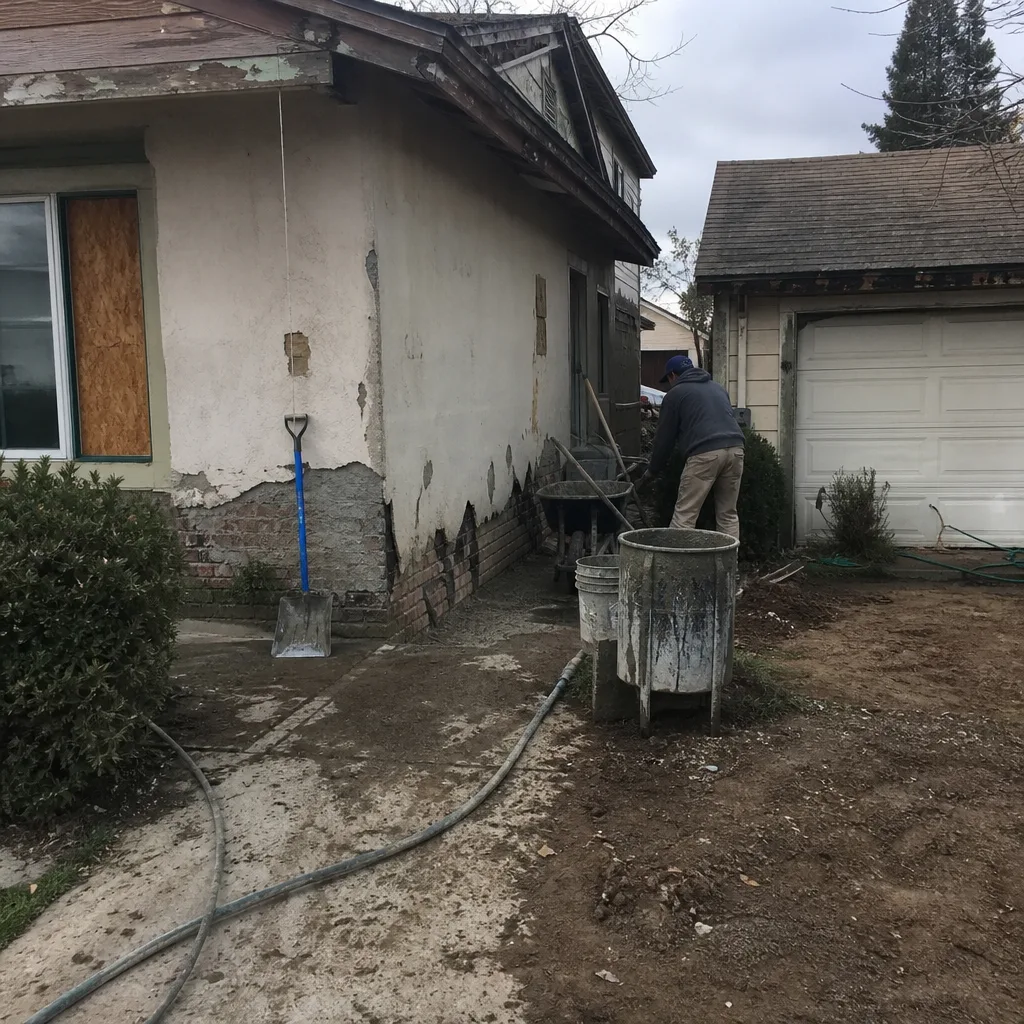
Substrate failure looks different. The crack is wider, often vertical or diagonal, and it runs through the entire stucco thickness. You’ll sometimes see rust staining below the crack, which means water has reached the metal lath behind the stucco, and the lath is corroding. That’s the point where a cosmetic problem becomes a water intrusion problem, and water intrusion in a Riverside stucco wall rots the sheathing behind it. By the time you see staining on the inside wall, the repair is a rebuild, not a recoat.
Inspect your stucco twice a year. March, before the heat season. October, after the monsoon season. Look at the south and west exposures first. They take the most sun. Check around window corners and door headers. Those are the highest-stress points because the wall can’t move freely at the opening. If you can fit a credit card edge into a crack, it needs a professional look. And in our experience, the homes that get inspected on a schedule are the ones that never need a full re-stucco. The ones that get ignored until the crack is wide enough to see from the street are the ones that cost real money.
For exteriors, we work with documented materials like James Hardie and Therma-Tru because the manufacturer’s spec tells us exactly how the product performs under UV and thermal load. It’s not a guess. It’s a spec.
Warranty-Required Maintenance vs. Optional but Smart Work
Most California homeowners don’t realize their builder’s warranty is a contract, not a promise. It spells out what the builder covers and what the homeowner must do to keep that coverage valid. Skip the required maintenance, and the warranty doesn’t protect you when the failure happens. This is true for new construction and for major remodels. The contractor’s warranty typically covers workmanship, but it almost always includes an implied maintenance obligation on the homeowner’s side.
Here’s the split. Warranty-required items are things like keeping drainage systems clear so water doesn’t pool against the foundation, replacing caulk and sealant at joints on a regular interval, and addressing any water intrusion promptly. The logic is simple: if you let water sit against the wall because you never cleaned the gutters, the resulting damage isn’t the contractor’s fault. The warranty assumes basic maintenance happens.
Optional but smart work is the longer list: resealing a deck every couple of years, repainting before the paint actually fails, lubricating door hardware, checking the HVAC condensate line. None of these are required by your warranty. All of them are cheaper than the repair you’ll pay for if you skip them.
The practical rule: read the maintenance section of your warranty. It’s usually one page. If the contractor didn’t give you a written warranty with a maintenance section, that’s a red flag before the first tool comes out. At Bradford Remodeling, every project gets a written warranty upfront. Our 365-Day Done Right Promise says it plainly: if the work fails inside the guarantee period, we come back and correct it at no charge. But that promise assumes the homeowner isn’t actively causing the failure. A written maintenance schedule, given to you at job close, is part of what Bradford Remodeling Co Riverside home projects include. It’s not an afterthought.
How to Document Maintenance So It Counts for Warranty and Insurance Claims
Here’s the part most homeowners skip, and it’s the part that costs them real money when a claim gets denied. Insurance companies and warranty providers don’t take your word for it. They take evidence. If you can’t prove you maintained the house, the claim gets denied even when the failure wasn’t your fault.
Documentation doesn’t have to be complicated. It has to be consistent. Do these steps and keep them in one folder, physical or digital:
- Take dated photos of every inspection. Phone photos are fine. Make sure the date stamp is on. Take a photo of the foundation, the stucco cracks, the gutter line, the roof from the ground. Every inspection, every time.
- Keep receipts for every material you buy. Caulk, sealant, paint, roof patch. If you bought it to maintain the house, the receipt is proof.
- Write a one-line note after every maintenance task. “April 12, 2026: Cleaned gutters, tightened downspout brackets, checked stucco for new cracks.” It takes thirty seconds. It’s evidence.
- File every contractor invoice, even small ones. A handyman fixing a loose downspout is maintenance. The invoice proves it happened.
- Photograph the house after major weather events. Riverside’s monsoon season can drop an inch of rain in an hour. If you file a water damage claim six months later, a photo from the day after the storm showing no visible damage is powerful evidence.
We tell homeowners this during Home Remodeling in Riverside projects: the documentation is part of the job close, not an optional extra. When we finish a project, you get a clean site, a documented scope, and a signed written guarantee in your hand. Your maintenance documentation extends that same discipline to the years after. And if you ever need to make a claim under our 365-Day Done Right Promise, the documentation tells us exactly what happened, and we make it right.
What Requires a Licensed Contractor in California vs. What You Can Self-Certify
California draws a bright line here, and it’s worth knowing where it is before you start a project. The Contractors State License Board (CSLB) requires a license for any project where labor and materials exceed $500, including the materials you buy yourself. That’s the legal threshold. Below it, and the work is considered a handyman task, which you can do yourself or hire unlicensed help for.
But the threshold doesn’t tell the whole story. Certain types of work require a licensed contractor regardless of price. Structural work, including foundation repair, always requires a license. Any modification to load-bearing walls requires a license. Roofing requires a C-39 license. Electrical, plumbing, and HVAC work require their own specialty licenses even for small jobs. If you’re touching a gas line, a panel, or a sewer connection, the law says licensed contractor, full stop.
Here’s where a homeowner can self-certify without running afoul of the CSLB:
- Painting your own house, interior or exterior. No license required unless it involves lead abatement on pre-1978 homes.
- Landscaping and drainage work that doesn’t involve structural changes or grading beyond the original grade.
- Replacing light fixtures, faucets, or toilets that don’t require moving plumbing or electrical runs.
- Caulking, sealing, and weatherstripping. This is maintenance, not construction.
- Deck refinishing where the structure itself is sound. Replacing deck boards is maintenance. Rebuilding the framing is not.
The line that surprises most homeowners: replacing a water heater requires a plumbing license if it involves gas or electrical connections. Replacing a kitchen faucet does not. Replacing a kitchen cabinet is a handyman task. Replacing the wall it hangs on is not. When in doubt, check the CSLB website. Or call a contractor who will tell you honestly which side of the line your project falls on.
The Seasonal Maintenance Schedule That Works in Riverside
Riverside doesn’t have four seasons. It has a long dry heat season and a short wet season. The maintenance calendar follows that rhythm. Here’s the schedule we give our clients, and it’s calibrated to the actual climate, not a generic template.
April: Post-Wet-Season Inspection
This is the critical one. After the last rain, before the heat. Walk the foundation, check the stucco, clean the gutters for the last time, and inspect the roof from the ground. This is when you catch soil movement, water damage, and UV damage that happened over the winter.
June: Pre-Heat-Season Prep
Before the first 100-degree week, check the HVAC condensate drain, replace the air filter, inspect weatherstripping on exterior doors, and check the water heater for sediment. A water heater that’s been running hard all summer costs more than a serviced one. Riverside’s summer energy load is real.
September: Monsoon-Season Audit
Riverside’s monsoon season runs July through September. After it ends, walk the property and look for erosion, standing water, or debris in the drainage system. Check the roof for lifted shingles. Check the stucco for new cracks. This is when water intrusion shows up, and the faster you catch it, the cheaper the fix.
October: Pre-Wet-Season Seal
Before the winter rains return, reseal any exterior wood, re-caulk window and door perimeters, and check that downspouts extend at least five feet from the foundation. This is the season when the clay soil under your house starts absorbing water again, so drainage matters more than any other time.
For a deeper dive on how this schedule applies to a specific remodel, see our Kitchen Remodeling in Riverside guide, where maintenance planning is built into the design phase.
Drainage, Gutters, and the Monsoon Season Reality
Riverside gets about 10 inches of rain a year. Most of it falls in a handful of storms. That’s the part generic checklists miss. A house in Seattle can handle a constant drizzle. A house in Riverside has to handle an inch of rain in forty minutes, then weeks of drying heat. The drainage system has to work perfectly for those short, violent windows.
Clean your gutters twice a year minimum. April after the wet season ends, and October before it begins. If you have trees near the roofline, clean them four times a year. Clogged gutters in Riverside don’t cause slow rot the way they do in wetter climates. They cause overflow that dumps water directly against the foundation, which saturates the clay soil, which swells, which moves the slab. A $100 gutter cleaning prevents a $10,000 foundation repair.
Check downspouts every time. The downspout has to extend at least five feet from the foundation. A splash block is not enough. Riverside soil doesn’t absorb water quickly, so a downspout dumping water three feet from the wall is the same as dumping it directly on the foundation. If you don’t have extensions, install them. It’s the cheapest insurance you’ll ever buy.
Also check the soil grade around the foundation. The ground should slope away from the house at a rate of about six inches over ten feet. Over time, soil settles and the grade flattens or slopes toward the house. Fixing the grade is a weekend job with a shovel and a load of topsoil. Skipping it means every rainstorm directs water into the foundation instead of away from it.
Common Mistakes to Avoid
- Ignoring a small slab crack because it’s “not that bad.” In Riverside’s expansive soil, a 1/8-inch crack this spring is a 1/4-inch crack next winter. The repair cost multiplies the longer you wait.
- Treating every stucco crack the same. Fine cosmetic checking is a recoat. A wide crack with rust staining is a substrate failure. The fix is different, and patching the wrong one with elastomeric coating hides the problem without solving it.
- Not documenting maintenance. When the insurance claim gets denied because you can’t prove you cleaned the gutters, you’ll understand why the photos matter. Start the folder today.
- Skimping on downspout extensions. Five feet from the foundation is the minimum. Two feet is the same as zero feet in a heavy monsoon storm.
- Doing structural work as a DIY project. California law requires a licensed contractor for structural work, and your homeowner’s insurance may not cover unpermitted work that fails. The savings aren’t worth the liability.
- Waiting until the dry season to check drainage. You can’t see how the drainage system performs when it’s not raining. Check it during and right after a storm. That’s when the failures show up.
- Skipping the pre-summer HVAC check. Riverside summers are long and hot. A service call in June is cheaper than an emergency call in August when the system fails at 4pm on a 105-degree day.
When to Call a Professional
Some things are maintenance. Some things are a professional’s job, and knowing the difference saves you money in the long run. Call a licensed contractor when you see a foundation crack wider than 1/8 inch, a stucco crack with rust staining, standing water near the foundation after a storm, or a roof leak that has reached the sheathing. These aren’t maintenance issues. They’re structural or water intrusion issues, and the repair has to be done right the first time. Bradford Remodeling Co Riverside offers our General Contractor services with free estimates in Riverside, call (424) 567-8472. We’ll tell you honestly whether you have a maintenance item or a repair project, and we’ll put the answer in writing.
Frequently Asked Questions
Once a year, in April after the wet season ends. Riverside’s expansive clay soil moves every winter, and the April inspection catches the damage while it’s still cheap to fix. If you see a new crack during the year, document it and check again after the next significant rain.
A crack wider than 1/8 inch, a stair-step crack in masonry, or any crack that changes width between seasons. Hairline cracks under 1/16 inch are usually cosmetic. The line between cosmetic and structural is narrow, so call us at (424) 567-8472 for a free estimate if you’re not sure.
Cosmetic checking can be patched by a homeowner with an elastomeric coating. But if the crack is wide, if you see rust staining, or if the crack runs through the entire stucco thickness, that’s a substrate failure and needs a professional. Patching a substrate failure cosmetically hides the problem while water continues to get in.
Most warranties require basic drainage maintenance, prompt repair of water intrusion, and regular resealing of caulk and sealant. Read the maintenance section of your warranty. If it doesn’t have one, that’s a problem. Bradford Remodeling includes a written maintenance schedule with every project, and our 365-Day Done Right Promise covers the workmanship for a full year.
Take dated photos of every inspection, keep receipts for materials, write one-line notes after every task, and photograph the house after major weather events. Keep everything in one folder. When a claim is filed, the evidence decides the outcome.
Yes. Riverside gets most of its annual rain in a few short storms, which means the drainage system has to handle a lot of water at once. Clean gutters before the wet season, extend downspouts five feet from the foundation, and check the soil grade after every major storm.
The Bottom Line

A maintenance checklist built for Riverside has to account for expansive clay soil, UV degradation, and short violent rain events. That means a foundation inspection every April, a stucco inspection twice a year, drainage work tied to the monsoon calendar, and documentation you can actually use in a claim. Skip the generic checklist. Follow the one that matches the climate you actually live in. And when you find something that needs a professional, get it looked at before the repair window closes.
Written by Curtis Lane, Owner at Bradford Remodeling Co Riverside, serving Riverside since 2004.
See the difference
 Before
 After
After Before
 After
After Before
 After
After